Japanese tattoos in Sydney
Japanese tattoos: what to know before you book
Japanese tattooing is built for large scale work: bold motifs, flowing backgrounds and designs that follow the body. It rewards planning.
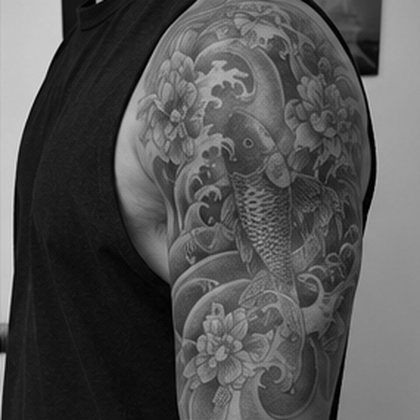
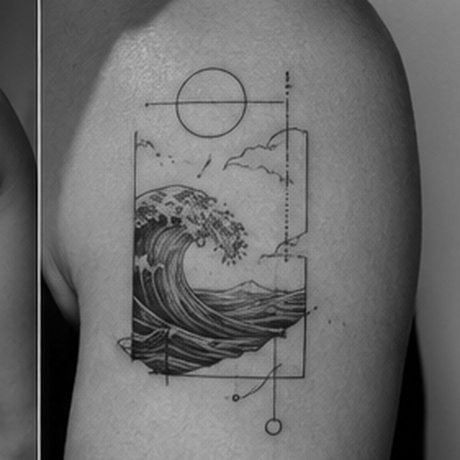
What japanese is
Irezumi is the Japanese word for tattoo, and in English it usually means this traditional style (Wikipedia). Its look grew out of Edo period woodblock prints, including illustrated editions of the novel Suikoden showing heroes covered in dragons, tigers and flowers.
Common motifs include koi, dragons, tigers, snakes, phoenixes, hannya masks, peonies, cherry blossoms, lotuses and chrysanthemums. Backgrounds of clouds, waves and wind bars tie the pieces together and fill the space around them (Wikipedia).
Traditional Japanese work can be done by hand, a method called tebori, or by machine. Most work today is done by machine.
Is it right for your idea?
Japanese work suits people planning something big, or something that could grow. A koi on the forearm can become a half sleeve, then a full sleeve, if the opening design leaves room for it. It also suits people who like strong, graphic images with a long tradition behind them.
It is a harder fit for very small pieces. The style depends on scale and flow, and a tiny motif without its background can lose what makes it Japanese. If you are not ready for a large piece, talk to the artist about a single motif placed so it can be extended later.
What to ask an artist
- What do these motifs mean together? Pairings and seasons carry meaning in this style. A specialist will guide you.
- How will the background flow? Ask how the design follows your muscles and where it could extend later.
- What is the full plan? A half sleeve is often one part of a bigger piece. Talk about where it might go in future.
- How many sessions? Ask for an estimate of sittings and the rate for each.
- Machine or hand? If you want tebori, ask whether the artist offers it.
How japanese ages
Research published in the Journal of Experimental Medicine found that tattoo ink is held by immune cells in the skin, which take the ink up, die, and pass it on to new cells (NBC News on the study). That cycle is why tattoos last.
Japanese work is designed to be read from a distance. Bold outlines, strong contrast and solid backgrounds give it structure that holds up as the years soften every tattoo. Large areas of colour fade faster in the sun, so sunscreen matters on exposed arms.
Typical sizes and session lengths
This is mostly large work. As a guide, the Canvs pricing tool starts a large half sleeve at about 5 hours and a full day at about 7 hours, and each artist sets their own. A half sleeve usually takes more than one sitting.
Full bodysuits are a long commitment. A traditional bodysuit can take up to five years of weekly visits (Wikipedia). Most people start with a sleeve or a back piece.
What drives the price
- Background coverage. Backgrounds fill every gap, so almost no skin is left bare. The Canvs pricing tool starts Japanese at x1.25 on the hourly price.
- Colour. Colour adds passes and ink changes. The tool starts colour at x1.2 over black and grey.
- Size and sessions. Many artists charge a day rate for big work. See our Sydney tattoo cost guide.
- Placement. Back and chest pieces start at x1.1, because the design has to wrap a curved surface.
Looking after it
Follow your artist's aftercare instructions while it heals. Keep a healing tattoo out of the sun, and once it has healed, use broad spectrum sunscreen of SPF 30 or higher. Sun exposure can fade and crack tattoos early (Journal of Clinical and Aesthetic Dermatology; American Academy of Dermatology).
See japanese tattoo artists in Sydney
Get early access.
We'll let you know when Canvs opens near you.
Get early accessSources
- Wikipedia, "Irezumi"
- NBC News, "Why do tattoos last forever?", on the Journal of Experimental Medicine study by Baranska and colleagues, 2018
- Gonzalez, Walkosz and Dellavalle, "Aftercare instructions in the tattoo community", Journal of Clinical and Aesthetic Dermatology, 2020
- American Academy of Dermatology, "Caring for tattooed skin: tips from dermatologists", via Newswise, 9 September 2014
- Canvs pricing tool defaults (sizes, style and placement factors), November 2026. Each artist sets their own.